A couple who books a venue a year in advance, secures a caterer and photographer, then discovers on the big day that the sound system is crackling and guests are bored between dessert and the first dance. This scenario often repeats because wedding planning focuses on logistics at the expense of what truly makes the day memorable: the rhythm, the ambiance shifts, and the unexpected details.
Wedding Day Rhythm: Avoiding Downtime Between Ceremony and Reception
The most common pitfall is the two-hour gap between the end of the ceremony and the start of the meal. Guests wander, children fidget, and energy wanes. This time slot can be structured differently.
The most effective solution is to break the day into short sequences with changes of location or activity. A cocktail reception that lasts too long without entertainment becomes a dull moment. Conversely, if a move to a second space (garden, terrace, courtyard) is planned, the simple act of walking re-engages attention.
Resources like party-wedding.info allow for exploring reception formats that break the classic linearity, incorporating highlights spread throughout the duration of the celebration.
In practice, it’s beneficial to plan at least three ambiance changes throughout the day: one for the ceremony, one for the meal, and one for the evening. Each transition should be accompanied by a clear signal (music, lighting, movement) so that guests feel a new moment is beginning.
Wedding Decoration and Atmosphere: Creating a Cohesive Visual Identity
We often see weddings where each element is beautiful in isolation (the bouquet, the centerpiece, the arch) but where the overall effect lacks coherence. The result resembles a Pinterest catalog rather than a personal universe.
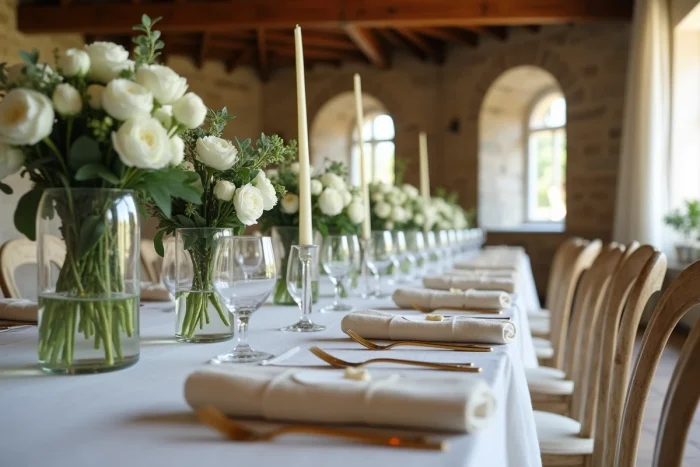
The difference between a “pretty” wedding and one that is memorable lies in a unified artistic direction. This doesn’t mean matching everything in the same color. It means choosing three to four recurring elements (a material, a palette, a pattern, a type of lighting) and applying them consistently.
- The signage (table plan, directional signs, menu) uses the same typography and paper as the invitation, creating an immediate impression of coherence.
- Lighting does more than floral decoration to create an atmosphere: filament garlands, low candles on tables, and indirect lighting in the evening transform any reception venue.
- Flowers should follow the season and location rather than an ideal seen in photos. A barn wedding with imported peonies in December is noticeable, and it’s expensive for an artificial result.
A memorable decor tells something about the couple, not about a trend. A personal object repurposed as a decorative element (vinyl records, books, travel postcards) anchors the wedding in a story that guests recognize.
Wedding Budget: Making Choices Among Vendors for a Memorable Result
The budget for a wedding is rarely allocated optimally. We often overinvest in decoration or the dress, while underestimating the cost of what directly impacts the guest experience: music, meal quality, and coordination.
Vendors to Prioritize for Evening Atmosphere
If choices must be made, the DJ or musical group deserves a larger share of the budget than floral decoration. Feedback varies on this point, but most guests remember the dance floor much more than the centerpieces.
The caterer plays a comparable role. An average meal in a beautiful setting leaves a mixed memory. An excellent meal in a simple venue leaves a strong memory. The hierarchy of these expense categories should be considered early, before deposits lock in choices.
The Often Overlooked Item: Day-of Coordination
The time needed for coordination on the wedding day is consistently underestimated. The couple cannot manage the caterer’s delays, guide the photographer, and welcome guests at the same time. Delegating coordination to a dedicated person (a professional or an organized friend with a detailed schedule) radically changes the experience for the couple.
This person does not need to organize everything in advance. Their role is limited to the wedding day: checking schedules, following up with vendors, managing unforeseen events. It’s a modest investment that prevents the couple from spending their day solving logistical problems.

Choosing the Reception Venue: Ground Constraints Not Shown in Catalogs
Photos of reception venues can be misleading. A stunning estate in pictures may pose real problems: insufficient parking, an un-equipped kitchen forcing the caterer to bring everything, no backup plan in case of rain, disastrous acoustics under a stone vault.
Before signing, it’s wise to visit the venue at the time the reception is scheduled (not in the afternoon when the light is flattering). You should test the acoustics by speaking from the ceremony space, check the electrical capacity if sound equipment is planned, and explicitly ask what restrictions apply (end time, noise level, delivery access).
- Check if the venue imposes exclusive vendors (caterer, DJ) or allows free choice, as this impacts both budget and quality.
- Ask for the maximum number of seated AND standing guests, as these two figures often differ significantly.
- Ensure that a sheltered area can accommodate all guests, not just half, in case of bad weather.
The ideal venue is one that works in the worst weather scenario, not just in the sunshine. An outdoor wedding without a real backup solution remains a gamble, even in summer.
A wedding remembered ten years later is not about the budget or the number of guests. It’s about well-thought-out transitions, a venue tested against its real constraints, and a few deliberate choices that reflect the couple rather than a standard model.