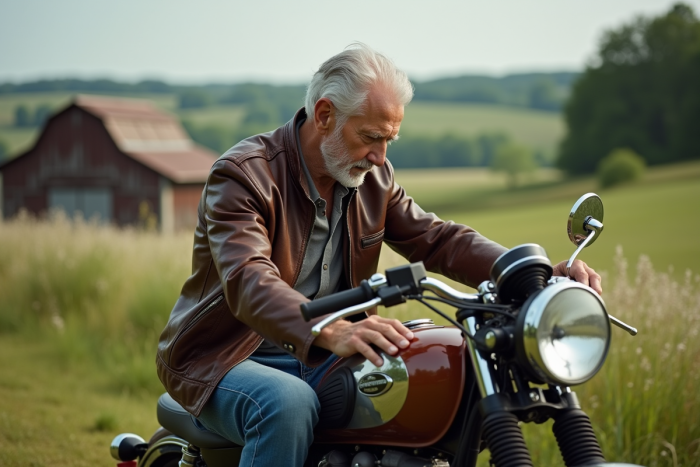
Some models designed between the 1960s and 1980s today display love ratings far exceeding their original prestige. While mass production imposed choices dictated by profitability, some atypical machines, remaining in the shadows of market leaders, still defy commercial logic.
Their current rarity does not reflect either their technical contribution or their potential. This distortion between public recognition and real value raises questions about the criteria for success and the industrial legacy left by these forgotten motorcycles.
Why some vintage motorcycles remain in the shadows despite their unique character
In the great rush of the motorcycle world, a few machines from the past, despite having a unique mechanical character, remain on the fringes of the spotlight. Their personality clashes head-on with the dictates of Euro 4 and Euro 5 standards that have, for years, restricted the circulation of 2-stroke engines. This type of engine, with its simplified maintenance, lightness, and instant vigor, continues to resonate with collectors and motorcycle enthusiasts. However, it remains stigmatized for its polluting emissions and its thirst for oil and gasoline, which is much greater than that of 4-stroke engines.
The cycle of the 2-stroke engine, with two piston movements, creates unfiltered sensations. Yet, the requirement for regular maintenance—spark plug, air filter, rings, piston, exhaust—cools the enthusiasm of many, especially among recent motorcycle enthusiasts, accustomed to calibrated reliability. Criticisms regarding their limited longevity and appetite have not tarnished the aura of these machines. A circle of die-hards continues to embrace them, driven by the desire for a pure connection with the machine.
New ecological constraints have disrupted the market: the sale of new 2-stroke engines is dwindling, and rarity sharpens speculation. Yet, some models, take the Honda XR600L, for example, this robust classic that still attracts enthusiasts, illustrate the persistence of an indomitable motorcycle spirit. Collectors search, restore, and recount, resurrecting these witnesses of an era when technique was synonymous with boldness, not conformity.

Underestimated models to rediscover: hidden assets and unexpected comparisons
On the second-hand market, several 125cc motorcycles with 2-stroke engines defy predictions. Aprilia RS 125, Yamaha DTR 125, Cagiva Mito 125, Suzuki RG 125 Gamma, and Peugeot Scoot’N 125: long relegated to the role of mere utility vehicles or machines for young riders, these bikes are experiencing an unexpected resurgence among motorcycle enthusiasts.
Here’s what explains this renewed interest:
- The remarkable power of these motorcycles, often exceeding that of 4-strokes of the same displacement, is due to the lively architecture of the 2-stroke engine. The short, brisk cycle offers sharp accelerations and immediate responsiveness at startup.
- The oil/gas mixture, whether provided by separate lubrication or manually, gives these motorcycles a raw temperament. With every kick of the starter, every surge in revs, it’s a direct reminder of racing, of the exploits of Mike Hailwood or Phil Read on legendary circuits.
Their dashboard reduced to the essentials, the sharp design, and ease of maintenance appeal to those seeking an unadulterated experience, far from the omnipresent assists found on modern models. Parts such as rings, piston, spark plug, air filter, and exhaust are still accessible, allowing these icons to continue their journey. Whether in the bustling streets of Paris or on the tight turns of Monaco, these 125cc motorcycles prove that a vintage bike can still break records and thrill those seeking mechanical authenticity.
Forgotten motorcycles, away from the podium, have never stopped keeping the tempo for those who know how to listen. Perhaps around a corner or at an auction, the next gem is already waiting to be rediscovered.