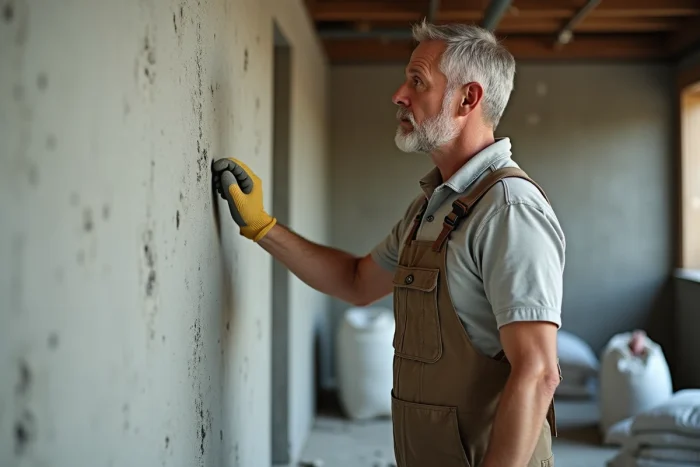
An unbalanced cement/sand ratio guarantees a floor that crumbles at the slightest movement. Adding too much water for flexibility weakens the support throughout its lifespan. By constantly smoothing over the edges or neglecting preparation, we mainly create dust and frustration, where a solid base was expected.
Understanding why the dosage of lean screed makes all the difference
Here, precision is not an accessory: it is the very foundation of the result. Miscalculated dosage, and the screed turns into an unbearable sandy mat. Too much sand or water, not enough cement… the slightest deviation compromises strength. Specifically, this floor will neither support tiles safely nor serve as a reliable foundation for parquet.
The rule, unsurprisingly, remains relentless: 1 volume of cement for 4 to 5 volumes of sand, with just enough water to keep the mixture firm, never liquid. This calibration prevents the surface from sagging, cracking, or accumulating dust from the very first steps. Respecting these balances protects the work from premature repairs and gives the floor the expected resistance.
When it comes time to apply, nothing replaces the method. The thickness must adhere to the project requirements: you do not pour a fluid or traditional screed with the same tolerance level or the same amount of water as for an anhydrite or fiber-reinforced screed. It’s easy to make mistakes, yet reliable resources exist, starting with the concrete details listed in this specialized article on mistakes to avoid with a too-sandy screed.
In this operation, improvisation is not a friend. The final quality of the floor, and the reputation of the project, simply depend on it.
What are the recommended dosages and how to calculate them easily according to your surface?
It’s impossible to aim accurately without adjusting the quantities of materials: the success of a screed depends on a precise combination. The baseline followed by professionals: 1 volume of cement and 4 to 5 volumes of sand. For water, you never add too much, only what is necessary for the mortar to maintain a firm texture that doesn’t stick to your fingers and doesn’t spread like dough.
Take a concrete example. With a 35 kg bag of cement, count approximately 100 to 125 liters of dry sand (4 to 5 bags), then 15 to 18 liters of water, added gradually to control the consistency. For a screed of 5 cm thickness, the amount to plan will depend on the surface: calculate in advance, adding a small margin to account for losses or irregularities on site.
To structure your needs, here are the appropriate benchmarks based on thickness and area:
- For 1 m² at 5 cm thickness: you need 11 to 13 liters of cement, 45 to 55 liters of sand, and 6 to 7 liters of water for an optimal result.
- In case of using lime, adjustments are necessary: reduce the amount of water, as lime already offers more workability.
The choice of sand also lays the foundation for the final quality: always clean, rinsed, graded from 0 to 4 mm, and obviously, without any traces of clay. With a homogeneous mix, the screed holds no unpleasant surprises during the flooring installation.
Too sandy finishes, dust: the 7 mistakes to avoid and our tips to correct them
Error #1: Excess water
When water is added without control, the mortar weakens suddenly. As a result, the cement separates, the texture becomes powdery, the surface cracks, and dust settles everywhere. Always add water gradually, continuously checking the consistency before proceeding.
Error #2: Poor choice of sand
Sand that is too fine or poorly washed harms stability. To ensure strength and cohesion, choose clean 0/4 sand, free of clay.
Error #3: Random cement dosage
Lacking binder ruins the strength of the screed. Respect the proportions or risk seeing the surface crumble. Conversely, an excess of cement causes quick cracks under load.
Other pitfalls await during installation or preparation; it’s better to anticipate them:
- Neglecting compaction: if the mortar is not well compacted with the rule and trowel, dust accumulates and the surface crumbles.
- Rushed drying: the screed needs gradual hardening, protected from any heat source or direct air.
- Neglected support: dusting, moistening, checking flatness… Preparations offer their share of security for final adhesion.
- Curing too quickly: rushing to lay a covering generates early cracks and sagging, a real setback.
Every step hinges on the smallest detail. It is observation, sure gestures, and mastery of mixtures that truly prevent dust and a sandy appearance. The difference? A completed project without needing to revisit it tomorrow.