
Your first day on track is approaching, and the equipment list looks like an endless catalogue. Racing suit, helmet, gloves, shoes, fire-resistant underwear: where should you start when choosing your motorsport gear without making the wrong choice or breaking the bank? Before you even look at product specifications, one simple step can help you avoid most purchasing mistakes.
Organizer’s regulations: the real starting point before you buy anything
Have you already spotted a helmet or racing suit you like online? Before reaching for your credit card, get a copy of the regulations for the track day you plan to attend. Requirements vary depending on the organizer, the type of event and the circuit itself.
A recreational track day in France does not always have the same requirements as a licensed race. Some organizers ask for an approved full-face helmet without specifying a particular standard. Others require an FIA-homologated racing suit. Check the organizer’s requirements before every purchase, as equipment that is perfectly suitable for one event may be rejected at another.
Vehicle technical inspections work the same way. Inspection forms cover the condition of the brake pads, brake fluid level, tires and even battery mounting. These requirements vary from one event to another. In short, the first piece of equipment to get isn’t a helmet: it’s the regulations for your next track day.
Specialist catalogues such as the one available at redracinggreen.be make it easy to compare products with the standards required for each type of competition or recreational track day.
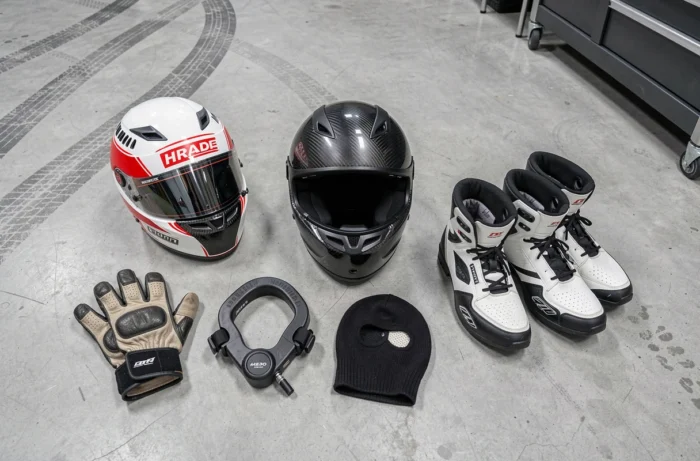
Motorsport helmets for the track: choosing the right homologation
The helmet is the most visible and often the most expensive piece of a driver’s equipment. There are two main types: Snell-certified helmets (common in North America) and FIA-homologated helmets, which are more widely used in Europe for competition.
FIA or road standard: what’s the practical difference?
A motorcycle or standard road helmet is designed to protect against a single impact. An FIA-homologated helmet is built to withstand hazards specific to motorsport, including flying debris and fire, and to work with a head-and-neck restraint system (the well-known HANS). A road helmet is no substitute for a track helmet, even if it looks like a full-face helmet.
Validity period and the second-hand market
FIA homologations have an expiry date. A helmet with expired homologation may be accepted at some recreational track days, but rejected in official competition. If you buy second-hand, check the label inside for the year of manufacture and the standard. Appearance alone isn’t enough: a previous impact, even one that left no visible mark, can compromise the internal structure.
Racing suit, gloves and shoes: putting together a well-matched set
Buying each item separately without considering how they work together is a common mistake. Racing suits, gloves and shoes function as a system. Their shared purpose is to protect you from fire for several seconds in the event of an incident, while allowing enough freedom of movement to drive precisely.
The racing suit: fit and comfort come first
A suit that’s too tight across the shoulders restricts steering movements. If it’s too loose, it creates folds that chafe after two hours on track. Before checking the homologation level, try it on and simulate your driving position: arms extended in front of you, feet braced.
Single-layer suits are suitable for short track days. Multi-layer models offer longer fire resistance, making them better suited to competition. Choose the number of layers based on how you actually drive, not on a hypothetical future use.
Gloves and shoes: precise control inputs
Motorsport gloves are thin, with external seams to avoid interfering with your feel for the steering wheel. Motorcycle or ski gloves, even if fire-resistant, don’t offer the same sensitivity. For shoes, a thin sole lets you control the pressure on the pedals. Here are the key points to look for:
- External seams on gloves to maintain direct contact with the steering wheel and prevent pressure points
- A thin, flexible sole on shoes that transmits pedal resistance to your foot without cushioning the feedback
- A high-top shoe that protects the ankle without restricting the flex needed for heel-and-toe shifting
- Fire-resistant materials that meet the standard required by the organizer

Fire-resistant underwear and HANS: the items beginners forget
Your racing suit doesn’t work alone. Fire-resistant underwear (balaclava, top, bottoms and socks) adds a layer of thermal protection directly against your skin. Without it, the suit is less effective in the event of a fire.
A fire-resistant balaclava is the item beginner drivers most often forget. It protects the neck, chin and part of the face—areas not fully covered by the helmet. It also costs relatively little compared with the rest of your equipment.
HANS system: not just for professionals
HANS (Head And Neck Support) limits forward head movement during a frontal impact. It requires a compatible helmet fitted with special attachment clips. If you’re considering moving into competition, make sure your helmet is compatible from the outset. Buying a helmet without clips and then having to replace it a few months later doubles the cost.
Tires and brakes: the hidden costs of track driving
A driver’s equipment isn’t limited to what they wear. Tire choice directly affects vehicle maintenance costs. High-grip tires provide more traction through corners, but put greater demands on the brake pads and brake fluid.
Higher-performance tires accelerate brake wear. It’s worth considering this trade-off before you buy: a set of semi-slick tires on a production car can lead to brake consumables costing more than the tires themselves. For your first track day, road-performance tires are generally sufficient and help keep overall costs down.
- Check tire pressures after every session, as heat can significantly change inflation pressure
- Bring a spare set of brake pads if you’re doing several sessions in one day
- Choose tires to match your skill level: excessive grip on a production chassis can mask mistakes in your racing line rather than help you correct them
Track driving should be planned as part of an overall budget. Driver’s gear, mechanical consumables and entry fees: considering each expense in isolation often leads to surprises at the end of the season. A well-chosen entry-level homologated setup is a better option than a high-end helmet paired with unsuitable gloves and worn brakes.