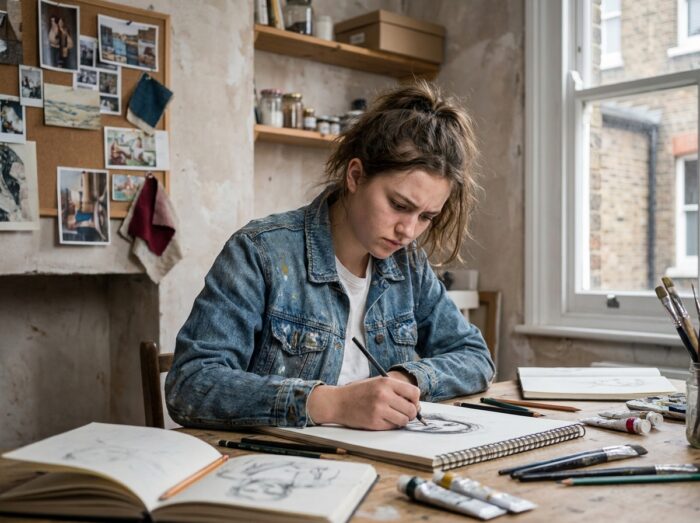
You are graduating from general high school, you haven’t taken the visual arts specialty, and your report card doesn’t stand out with its averages. The artistic preparatory class seems reserved for confirmed creative profiles or STD2A students. This impression is misleading. Several public and private preparatory classes accept general high school graduates each year whose academic records are unremarkable, provided that the application shows something beyond just a line of grades.
Artistic preparatory class without arts specialty: what juries really look at
The classic reflex is to think that without an arts specialty or without a STD2A diploma, the door is closed. However, public institutions like ENSAAMA (Paris) explain that general high school graduates without an arts specialty are not excluded. The condition: to demonstrate documented artistic curiosity in a portfolio of works, even modest, accompanied by a solid motivation letter.
In practice, an artistic preparatory jury is not looking for a student who already draws like a professional. They are looking for a perspective. Someone who photographs their neighborhood, fills sketchbooks on weekends, or experiments with collage already has material to present. The technical level matters less than the personal approach.
Are you considering joining an artistic preparatory class after a general track without having followed an arts-oriented curriculum? The key lies in the ability to show that practice exists outside the school framework, even in a self-taught manner.
What replaces a good report card in an art preparatory application
When grades are average, the personal work portfolio becomes the main lever. No need for a graphic designer’s portfolio. Here’s what juries value:
- Regular research notebooks (sketches, annotations, glued photos) that show a sustained practice over several months, not a last-minute sprint.
- Varied creations in at least two or three different mediums (drawing, photography, sculpture, collage, short video), even if the result is imperfect.
- A motivation letter that explains a specific curiosity journey, not a generic love declaration for art. Telling why an exhibition, a film, or a place sparked the desire to create works better than a list of adjectives.
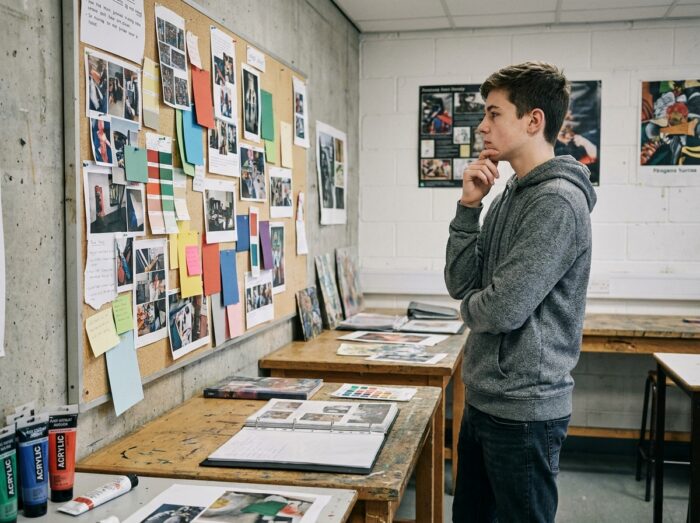
Recruitment outside Parcoursup: an unknown option for fragile applications
Many candidates are unaware: several public art preparatory classes recruit outside of Parcoursup. The CPES-CAAP (preparatory classes for higher education, support classes) linked to art schools often operate with their own admission procedures. The academic record weighs less heavily than in a traditional Parcoursup selection.
This parallel circuit benefits atypical profiles. A student with an average report card in general high school, but a coherent portfolio of works and a convincing interview, can secure a spot where the Parcoursup algorithm would have ranked them at the bottom of the list.
How to spot these preparatory classes with direct enrollment
Public art schools (those that award the DNA or DNSEP) often offer their own preparatory year. Enrollment then goes through the school’s website, with a schedule that does not follow that of Parcoursup. Application deadlines vary from one institution to another, with some extending into the spring.
Checking each public art school’s website individually remains the most reliable method. Lists published by ONISEP or the Ministry of Culture reference existing CPES-CAAP, but enrollment procedures change from year to year.
The artistic preparatory class is not a mandatory step for art schools
A point often lost in the surrounding discourse: no public art school formally requires a preparatory year. Each year, high school students are admitted directly after the general baccalaureate, or even after starting a university course. The preparatory class is a lever, not an administrative prerequisite.
Why choose it anyway when you have a fragile application? Because it offers a year to build what is lacking: a solid portfolio, structured artistic knowledge, and above all, oral fluency that makes a difference during entrance exams for higher education schools.

When the preparatory class compensates for an average academic record
In one year of preparatory class, a student produces enough work to create a credible portfolio. Art schools judge candidates based on their recent production, not on their final year grades. A portfolio built in preparatory class can overshadow an average report card in the eyes of an entrance exam jury.
The preparatory class also allows students to discover disciplines they have never practiced: engraving, screen printing, modeling, video. For a general high school graduate who has only experienced drawing as an amateur, this exposure to varied mediums transforms the application.
Admission interview for art preparatory class: preparing for the oral when you don’t have the typical profile
The motivation interview often represents half of the evaluation. Juries ask questions about the candidate’s cultural practices, references, and projects. A general high school graduate without artistic training may feel at a disadvantage.
The solution is simple: building a personal visual culture over a few months is enough. Visiting exhibitions (even free ones), watching documentaries about contemporary artists, reading a magazine like Artpress or Beaux Arts Magazine. The jury does not ask for an encyclopedia. They want to sense authentic curiosity and the ability to talk about what one has seen.
- Prepare three or four artistic references that you can comment on in your own words, not memorized notes.
- Be able to explain your portfolio piece by piece: why this subject, what material, what you learned while creating it.
- Be willing to say what you do not yet know. Juries prefer an honest candidate about their gaps to a candidate who recites hollow formulas about their passion.
The path to an art school from a general high school without a brilliant record relies less on grades than on the proof of personal commitment. A sketchbook filled over six months, a letter that tells a real spark, an interview where curiosity shines through: these elements weigh more than an overall average in the balance of an artistic preparatory jury.