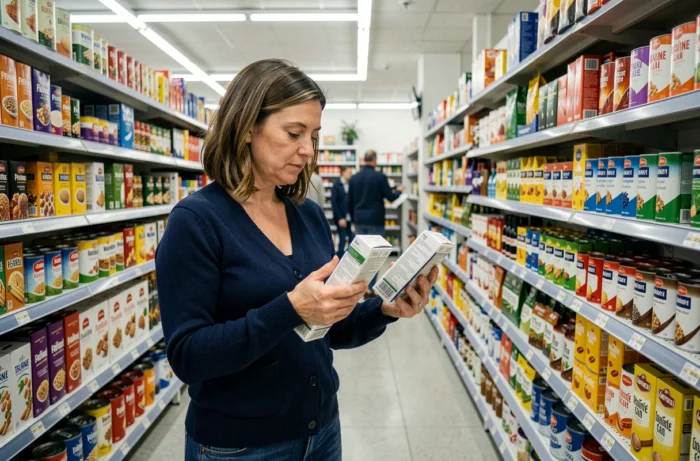
Private label brands now account for more than 45% of the volume of fast-moving consumer goods sold in France, according to NielsenIQ data from 2025. At E.Leclerc, the Marque Repère range occupies a central place on the shelves, from groceries to cleaning products. Understanding how this range actually works, its pricing mechanisms, and its limitations allows you to transform a traditional shopping cart into a lever for measurable savings over the year.
Marque Repère and Product Composition: What the Label Hides
A common reflex is to compare only the price per kilo between a national brand and its Marque Repère equivalent. This approach overlooks a decisive element: the ingredient list.
Several major retailers have announced commitments to reduce salt, sugar, and colorants in their private label ranges. These reformulations are not always visible on the packaging. For the same type of biscuit or prepared dish, the Marque Repère recipe can differ significantly from that of the national brand, sometimes for the better, sometimes with compromises on texture or taste.
Reading the composition line by line remains the only reliable way to judge whether the price difference corresponds to a real quality difference or simply to a difference in brand recognition. The Nutri-Score helps, but it says nothing about the origin of the raw materials or the manufacturing processes.
In practice, those who get the most out of Marque Repère in E.Leclerc stores apply a category-by-category sorting: some Marque Repère products are nearly identical to major brands, while others deserve closer examination.
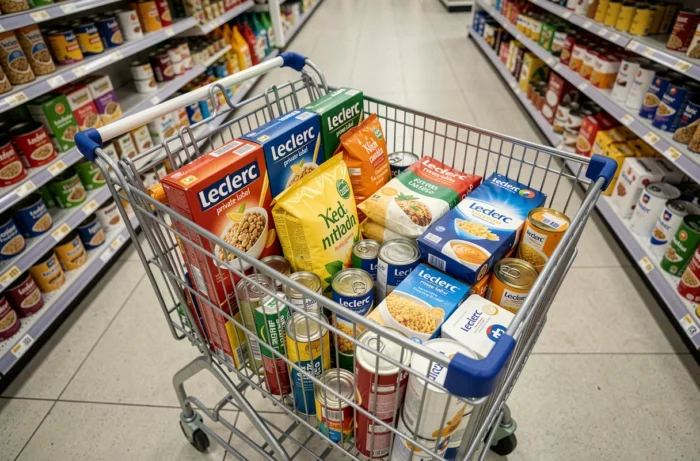
E.Leclerc Loyalty Card and Promotional Days: The Real Calculation to Make
The E.Leclerc loyalty card operates on a cashback principle. A percentage of the amount of certain products is credited to the card, usable during a later checkout. For Marque Repère products, this mechanism combines with targeted weekly promotions.
Some stores organize dedicated days for private labels, with enhanced loyalty benefits. Tuesdays often appear in local communications as Marque Repère promotion days, but each E.Leclerc store sets its own promotional calendar. Checking the flyer or the app before heading out avoids disappointments.
How Cashback Changes the Real Price
The price displayed on the shelf is not the final price for a cardholder. On certain Marque Repère items, the loyalty benefit can represent a significant fraction of the price. The catch: these cashback euros are not an immediate discount. They only become a real saving if you use them before expiration, and only on purchases you would have made anyway.
In other words, one euro saved on an unnecessary product remains an expense, not a saving. The relevant calculation concerns the overall annual receipt, not the percentage displayed on the shelf.
Marque Repère Promotions and Regulation: What Changes in 2026
The legal framework surrounding promotions and marketing claims is evolving. The European EmpCo directive (EU Directive 2024/825), which is set to be fully implemented by September 27, 2026, imposes stricter requirements on environmental claims and sustainability labels.
For consumers, this means that statements like “committed to the planet” or “responsible sourcing” found on some Marque Repère packaging must be based on verifiable evidence. A private label without independent oversight may be considered misleading under this new regulation.
This evolution does not directly change product prices, but it alters the value of marketing arguments. A Marque Repère product labeled as “eco-friendly” without transparent certification will lose credibility, which could prompt the brand to clarify its sourcing or remove certain claims.
False Good Deals: Traps to Spot on the Shelf
French regulations on promotions are also becoming more attentive to crossed-out prices. A few reflexes protect against “false good deals”:
- Compare the price per kilo or per liter, not the face price. A “maxi” Marque Repère format is not always cheaper per kilo than the standard format.
- Check the date of the crossed-out reference price. A 30% promotion on an inflated price from the previous week is not a real saving.
- Distinguish between immediate discounts and cashback. The former reduces the current bill, while the latter credits the card for a future purchase, which does not have the same impact on the monthly budget.
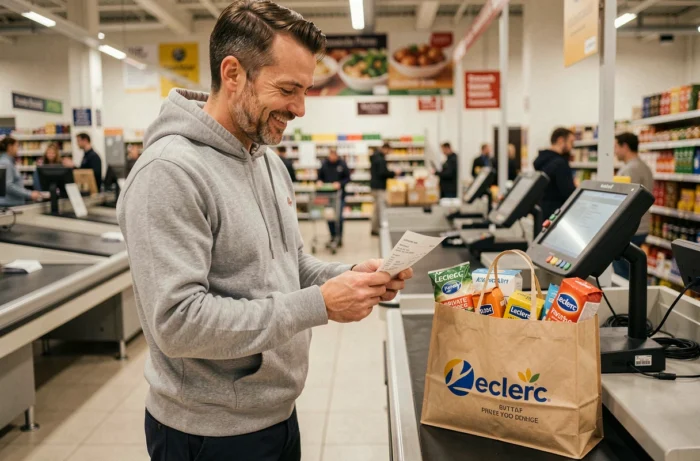
E.Leclerc Drive and Marque Repère: A Different Shopping Strategy
The drive changes the way we interact with Marque Repère products. In-store, packaging and shelf placement guide the choice. On the drive, sorting by price per kilo or by category makes comparison more direct.
The E.Leclerc drive interface allows filtering by brand, which facilitates the quick identification of Marque Repère equivalents for each product on the list. Preparing your list on the drive before going to the store allows you to spot price differences without the pressure of navigating the aisles.
However, some local promotions are not always reflected on the drive. “In-store only” offers exist, and vice versa. Cross-referencing the two channels provides a more complete picture of real prices.
- On the drive: sorting by price per kilo, direct comparison between private label and national brand, no impulsive purchases related to merchandising.
- In-store: access to local promotions of the day, ability to check the composition on the packaging, sometimes exclusive cashback offers.
- Combination of both: prepare the list on the drive, finalize in-store for fresh products and daily promotions.
The price gap between Marque Repère and national brands varies significantly by category. For basic products (flour, pasta, canned goods), the difference is often marked. For more elaborate products (prepared meals, cosmetics), the gap narrows and the composition deserves closer examination. The most noticeable savings are concentrated on minimally processed products, where the recipe difference between private label and national brand remains minimal.