The local leisure market has restructured in recent years around two axes: autonomous sports practices that require little equipment, and hybrid formats that combine several activities in one location. The National Barometer of Sports Practices 2025 from INJEP and Crédoc confirms the growth of running, cycling, Nordic walking, and trail running.
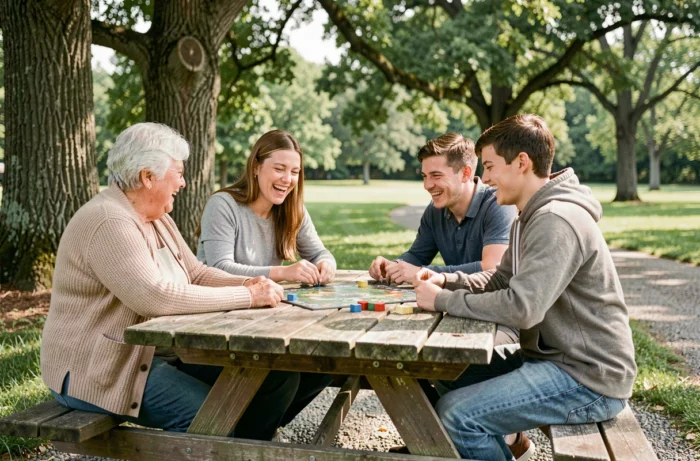
At the same time, families prefer outings that combine entertainment and learning, limiting travel while extending the duration of the experience.
Autonomous outdoor leisure: why it attracts a wider audience
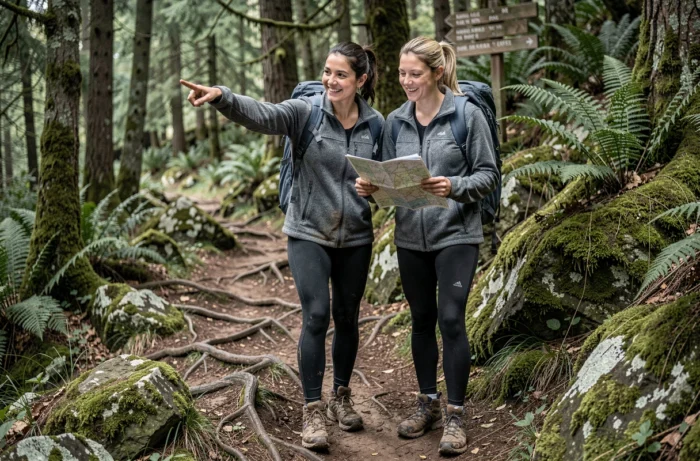
Hiking, geocaching, and trail running share a common point: no prior registration, no imposed time slots, and a nearly zero entry cost. This constraint-free model attracts profiles that do not frequent traditional sports clubs, particularly parents with young children and professionals with fragmented schedules.
Geocaching deserves special attention. This GPS treasure hunt transforms a simple walk into a playful journey. Children find a concrete goal (finding the cache), while adults discover trails they would not have taken otherwise. The absence of registration fees makes the activity accessible to all budgets.
Nordic walking, often perceived as reserved for seniors, is also gaining traction among thirty-somethings. It engages more muscle groups than regular walking and can be practiced on both urban and rural paths. Several municipalities are now creating marked loops specifically for this discipline, making access easier without a guide.
To explore other formats for outings with family or friends, the activities offered by Buzzarium cover a wide range of leisure options suited to different profiles and desires.

Indoor complexes and hybrid parks: how the concentration of activities changes things
Complexes that combine trampolining, climbing, laser tag, and dining under one roof respond to a simple logic: one trip for several hours of engagement. This format appeals to families with children of different ages, each of whom can choose the activity that suits them.
Large amusement parks follow the same trend by combining attractions, water areas, and on-site accommodation. The stated goal is to transform a day trip into a short stay, which alters the economic calculation for families. The cost per hour of activity decreases when staying on-site, even if the overall budget increases.
Limitations of this concentrated model
Feedback from the field varies regarding the quality of the experience in these structures. The concentration of activities sometimes generates a crowd that is difficult to manage, especially during school holidays. Waiting times can negate the advantage of a single location.
The other question concerns the real diversity of the activities offered. A complex that advertises ten different activities but relies on three types of equipment (inflatable structures, climbing walls, laser games) offers less variety than it seems. Checking the precise content before traveling helps avoid disappointments.
Educational outings with family: educational farms, scientific workshops, and themed visits
The trend of combining entertainment and learning is concretely reflected in three types of outings that are gaining popularity.
- Educational farms allow children to observe animals, participate in milking or harvesting. They provide direct contact with nature that urban parks do not replicate.
- Scientific workshops offered by some museums or associations transform abstract concepts into concrete manipulations: chemistry, astronomy, robotics. These formats work particularly well with 6- to 12-year-olds.
- Themed visits (heritage escape games, puzzle trails in castles or natural sites) add a narrative dimension that keeps the attention of both children and teenagers.
These three formats share a common trait: they involve participants rather than placing them as spectators. The difference with a traditional amusement park lies in this active participation, which often generates more lasting memories according to family feedback.
Accessibility of leisure activities: beyond ramps and reserved spaces
The accessibility of leisure activities is no longer limited to the presence of physical facilities. Recent sources, particularly those related to the organized Adapted Holidays program, emphasize three often-overlooked dimensions.
The first concerns the training of staff on different types of disabilities (motor, visual, auditory, mental). An adapted facility without trained staff remains an obstacle. The second pertains to the quality of information available before booking: knowing precisely what is accessible and what is not helps avoid unnecessary trips and frustrating situations.
The third dimension, less visible, relates to the effective adaptation of the activities themselves. An “accessible” treetop adventure course that consists of only one simplified route out of ten does not constitute a truly inclusive offer. Structures that rethink their activities so that all participants have a comparable experience, and not just a degraded version, remain in the minority.
A criterion of choice still difficult to evaluate
The available data do not allow for a reliable overview of the actual accessibility of leisure venues in France. Existing labels certify physical criteria (door widths, slopes, restrooms), but rarely the quality of welcome or the adaptation of activities. For the families concerned, word-of-mouth and detailed online reviews often remain the most reliable sources.
The landscape of local leisure is transforming without a sudden break. Autonomous outdoor practices continue to grow, hybrid formats are multiplying, and the issue of accessibility is gaining visibility without yet being resolved. The choice of a family outing increasingly relies on the ability to verify in advance what the venue actually offers, beyond its facade.