The structural diagnosis of a pool is not limited to the visible surface. A through crack in the slab, a detachment between the shell and the foundation, a pressurized hydraulic pipe that is leaking: these issues go unnoticed during a visual surface inspection. Before any in-depth maintenance, renovation, or installation project, the diagnosis of the structural work conditions every downstream technical decision.
Structural diagnosis of the pool: what the surface covering does not show
We recommend separating the evaluation into three distinct layers. The first concerns the structural work: slab, concrete walls, or steel panels, peripheral edge. The second focuses on the buried hydraulic circuit (discharge, suction, bottom drain). The third covers the waterproofing membrane itself.
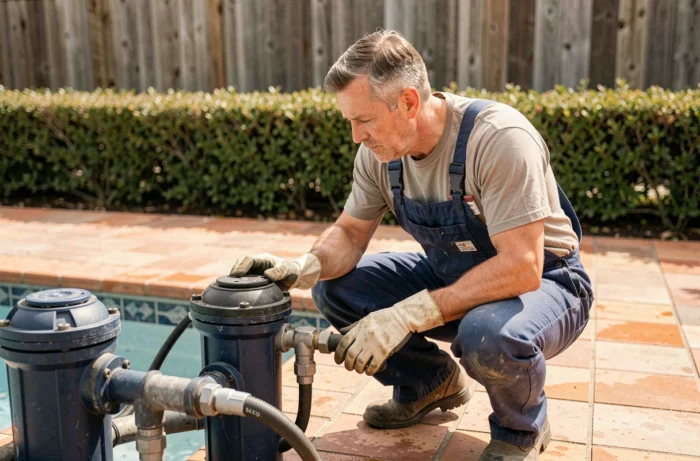
A water loss can originate from the pool or the hydraulic network. Before replacing a liner or resurfacing, a pressure test of the pipes allows for isolating the actual source of the leak. Without this test, changing the covering amounts to masking a problem that will reappear in a few months.
On concrete pools older than about fifteen years, the concrete repairs between the slab and the walls constitute weak points. A crack gauge measurement provides the exact width of a crack and allows for distinguishing simple surface crazing from an active structural crack. An active crack requires treatment with flexible resin injection, not just a rigid patch that will give way during the next freeze-thaw cycle.
On the ground side, a swelling clay soil can exert hydrostatic pressures on the walls. If the pool has been drained carelessly on this type of soil, irreversible deformations of the slab are possible. We regularly observe this phenomenon in pools where complete drainage has been performed during high water table periods.
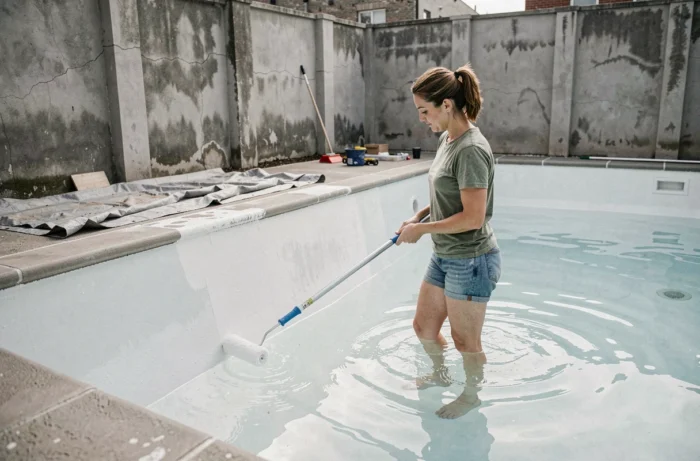
Owners looking to explore their renovation options, compare filtration technologies, or anticipate the costs of a complete project will find technical resources on the Refair website dedicated to pools, particularly for framing a project before consulting a pool professional.
Filtration and water treatment: balancing performance and consumption
Filtration ensures about 80% of water quality. The rest pertains to chemical or physical treatment. During a renovation or new installation, the choice of filter media and pump type deserves careful analysis.
The sand filter remains the most common, but its filtration capability is limited to about twenty microns. A recycled glass filter refines filtration and reduces the frequency of backwashing, thus decreasing water consumption. For a family pool, switching to glass filtration represents a measurable improvement in water clarity without modifying the existing tank.
Regarding the pump, replacing a fixed-speed model with a variable-speed pump significantly reduces electricity consumption. Modulating the flow rate based on water temperature (empirical rule: filtration time in hours equals temperature divided by two) optimizes the performance-consumption ratio.
Treatment: chlorine, salt, or UV
Stabilized chlorine remains the most common solution. Its main drawback: the accumulation of cyanuric acid (stabilizer) which eventually blocks the effectiveness of free chlorine. Beyond a certain threshold, the only solution is a partial drain.
- Salt electrolysis produces chlorine on-site and eliminates the handling of chemical products, but requires regular pH monitoring (the process tends to raise pH)
- UV-C treatment destroys chloramines and reduces the amount of residual disinfectant needed, without generating chemical by-products
- Ozone offers a higher oxidizing power than chlorine but requires a dedicated reactor and degassing before returning water to the pool
Each treatment system has a direct impact on the choice of associated equipment (automatic pH regulator, redox probe, electrolysis cell). We recommend defining the treatment before sizing the technical room.
Administrative and tax obligations related to the pool
Any pool larger than 10 m² requires at least a prior declaration of work. Beyond 100 m², a building permit is required. If the pool is covered by a structure exceeding 1.80 m in height, the project also shifts to requiring a building permit, regardless of the surface area of the water body.
In protected areas (surroundings of historical monuments, classified sites) or according to local PLU provisions, requirements may be stricter. A pool installed without authorization exposes the owner to a demolition order or regularization under conditions.
Tax declaration within 90 days
The pool must be declared to the tax administration within 90 days following the completion of the work, via the “Manage my real estate” space. This declaration leads to a reassessment of the rental value and, consequently, an increase in property tax. When the project is subject to urban planning authorization, the development tax also applies.
Pool safety: regulatory compliance and maintenance of the system
In-ground or semi-in-ground private pools must be equipped with at least one standardized drowning prevention device. Four options exist:
- Protection barrier (NF P90-306): minimum regulatory height, self-closing gate
- Safety cover (NF P90-308): must support the weight of an adult and prevent a child from immersion
- Pool shelter (NF P90-309): closed structure completely covering the pool
- Alarm (NF P90-307): immersion detection or perimeter, with audible alert
An alarm alone does not exempt from active supervision of children. During a renovation, we systematically check the compliance of the existing device. A system installed more than ten years ago may no longer meet updated versions of standards, particularly regarding detection sensitivity or the mechanical resistance of covers.
Maintaining the safety device is an integral part of the overall maintenance of the pool: testing the alarm trigger at the beginning of the season, checking hinges and cover tension, inspecting the condition of the tracks of a sliding shelter. A faulty safety device offers no real protection.
The choice between partial renovation and complete overhaul of a pool depends on the initial diagnosis, not the desired budget. A healthy slab with a worn covering calls for a targeted intervention. A pool showing structural issues combined with undersized filtration justifies a complete overhaul. In both cases, the sequence remains the same: structure, hydraulics, waterproofing, equipment, safety.